What Is a Board Foot?
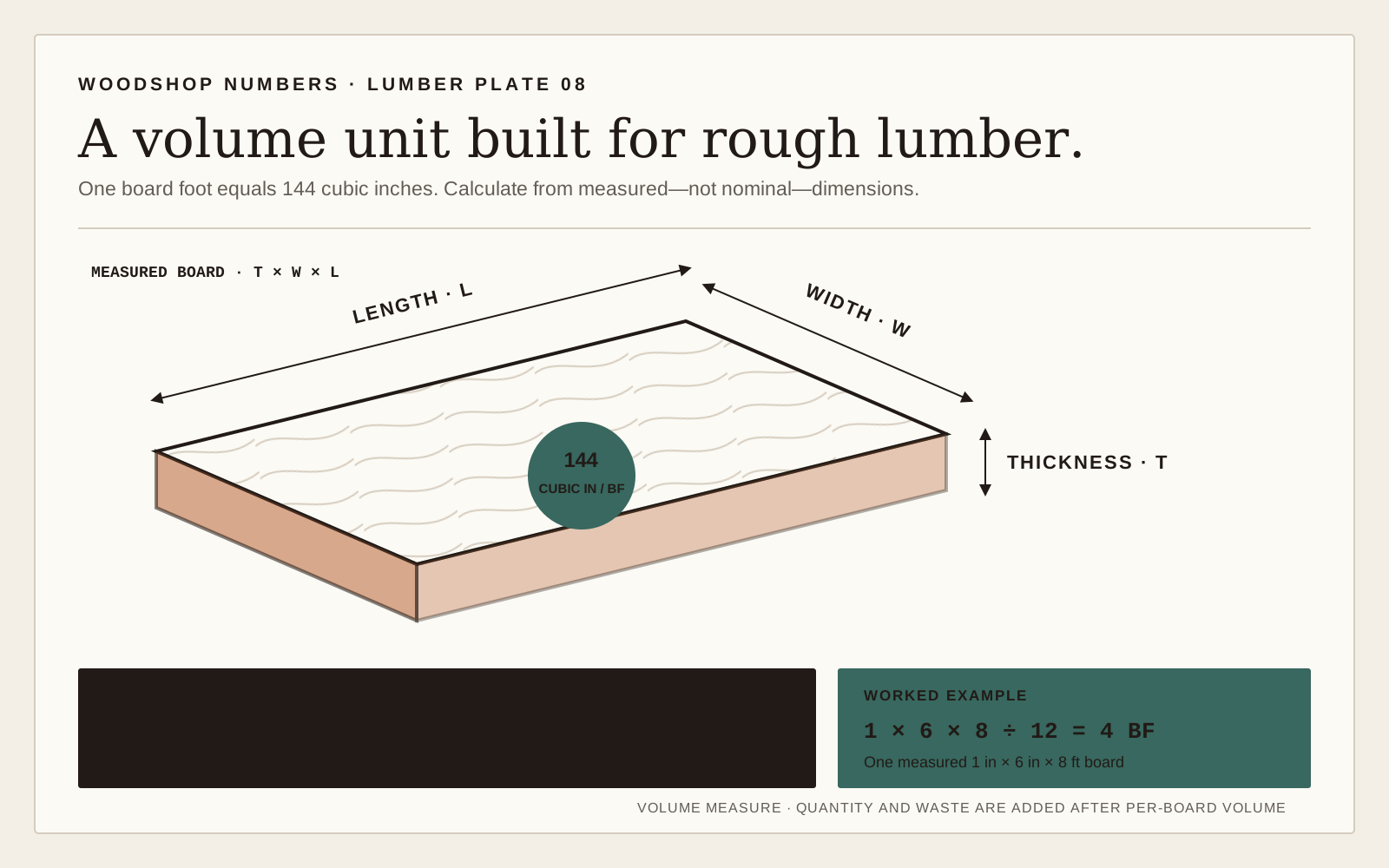
A board foot (abbreviated BF or bd ft) is a unit of lumber volume, not length or area. By definition, one board foot equals 144 cubic inches — the volume of a piece 12 inches long, 12 inches wide, and 1 inch thick. You can reach that same 144 cubic inches with any combination of dimensions: a 6-foot board that is 6 inches wide and 1 inch thick is also exactly one board foot.
The unit is useful because hardwood comes in random widths and multiple thicknesses. Board footage puts every board on the same pricing scale regardless of shape.
Why not square footage? Square footage measures flat area. A 2-inch-thick walnut slab and a 1-inch maple board of the same surface area are very different amounts of wood. Board footage captures the difference; square footage does not.
The Board Foot Formula
Two equivalent formulas — pick whichever matches how you are measuring:
Length in feet (most common at a lumber yard):
board feet = length (ft) x width (in) x thickness (in) / 12
All dimensions in inches:
board feet = length (in) x width (in) x thickness (in) / 144
Both formulas give identical results.
Worked Example
You are buying a cherry board that is 1 inch thick, 8 inches wide, and 6 feet long:
board feet = 6 x 8 x 1 / 12 = 4.0 BF
Buying five of those boards: 5 x 4.0 = 20 BF total.
The calculator at the top accepts thickness, width, and length (in feet or inches), plus an optional price per board foot. It returns board feet per board, total board feet for your quantity, and an estimated cost — all updating in real time.
The Quarters System: How Hardwood Thickness Works
At a home improvement store, lumber carries nominal sizes like "2x4" (actually 1.5 x 3.5 inches after milling). Hardwood dealers use a different system: quarters of an inch, measured on the rough-sawn board before any planing or surfacing.
| Designation | Rough-Sawn Thickness |
|---|---|
| 4/4 | 1 inch |
| 5/4 | 1.25 inches |
| 6/4 | 1.5 inches |
| 8/4 | 2 inches |
| 10/4 | 2.5 inches |
| 12/4 | 3 inches |
| 16/4 | 4 inches |
When you calculate board feet for hardwood, always use the rough-sawn thickness. If you order surfaced lumber (S2S or S4S), the finished board will be slightly thinner after milling — but pricing is based on the rough dimension. Enter the rough-sawn thickness into the calculator.
Example: 4/4 cherry, 8 inches wide, 10 feet long — thickness 1, width 8, length 10 ft — gives 6.67 BF per board.
Common Board Sizes: Board Feet Per 8-Foot Length
The comparison table on this page shows board footage for the most common hardwood sizes at an 8-foot length. Use it as a quick reference when estimating without a calculator.
Key takeaway: doubling thickness doubles board footage. An 8/4 board contains twice as much material as a 4/4 board of the same width and length — and costs roughly twice as much per square foot of surface.
Who Sells Lumber by the Board Foot?
Not every lumber source uses board foot pricing.
Uses board feet: hardwood dealers and lumber yards (walnut, maple, cherry, white oak, ash, exotic species); portable sawmills and local sawyers; online hardwood retailers.
Does not use board feet: big box stores like Home Depot and Lowe's sell standard dimensional lumber (2x4s, 2x6s, pine boards) by the linear foot or per piece.
If you are building furniture, cabinetry, cutting boards, or any hardwood project, you are almost certainly buying by the board foot. If you are framing walls or building a deck with standard SPF lumber, you will not need this calculator.
Planning a Full Project: Add a Waste Buffer
For a project that calls for multiple board sizes, work through your cut list piece by piece: measure thickness, width, and length for each part, calculate board feet, and sum all the results. Before ordering, add a waste buffer.
For rough hardwood, plan on adding roughly one board in five to cover defects, grain matching, and cuts that do not work out. For pre-surfaced boards, one board in ten is typically enough. The final number, rounded up to the nearest whole board foot, is your order quantity.
Most hardwood dealers price in half-board-foot or one-board-foot increments, so round generously rather than coming up short mid-project.
Board Feet for Logs
Calculating usable yield from a raw log uses different formulas than calculating board footage for sawn lumber. Two methods are common in the US:
Doyle Rule — the most widely used formula for private timber sales and portable sawmill operators: board feet = ((diameter_in - 4) / 4) squared, times length_ft. It tends to underestimate yield for smaller logs (under 16-inch diameter).
International 1/4-inch Rule — more accurate for smaller-diameter logs; used by forestry agencies and extension services.
The board foot calculator on this page is designed for sawn lumber (boards, planks, and slabs), not raw logs.
Board Feet in Spray Foam Insulation
Spray polyurethane foam (SPF) insulation is also sold and rated in board feet. The unit is identical — 1 sq ft of surface covered at 1 inch of depth equals 1 board foot.
A closed-cell kit rated at 600 board feet can cover 600 sq ft at 1-inch thickness, or 300 sq ft at 2-inch thickness, or 200 sq ft at 3-inch thickness.
You can use this board foot calculator for spray foam planning: enter the wall or ceiling area as length x width, set thickness to your target foam depth in inches, and set quantity to 1. Add a small overage for application yield variation.
| Nominal size | Thickness | Width | Board feet (8 ft) |
|---|---|---|---|
| 1x4 | 1 in (4/4) | 4 in | 2.67 BF |
| 1x6 | 1 in (4/4) | 6 in | 4.00 BF |
| 1x8 | 1 in (4/4) | 8 in | 5.33 BF |
| 5/4 x 6 | 1.25 in (5/4) | 6 in | 5.00 BF |
| 6/4 x 6 | 1.5 in (6/4) | 6 in | 6.00 BF |
| 8/4 x 6 | 2 in (8/4) | 6 in | 8.00 BF |
| 8/4 x 8 | 2 in (8/4) | 8 in | 10.67 BF |