How to Think About Building a Tool Kit
The right question is not "what do all woodworkers own?" It is "what do I need to finish my first five projects?" Tool needs grow with project complexity. Buying a large set upfront means acquiring tools you cannot yet use well — and money tied up in gear instead of wood.
A useful framework: start with the cut, measure, and fasten tools that every project requires, then add specialty tools as specific projects demand them. Every tool on this list earns its keep on project one.
The Essential Hand Tools (Start Here)
Tape measure — 25 feet, with a 1-inch-wide blade so it stays stiff when extended. Cheap tape measures drift in accuracy; buy a name-brand one.
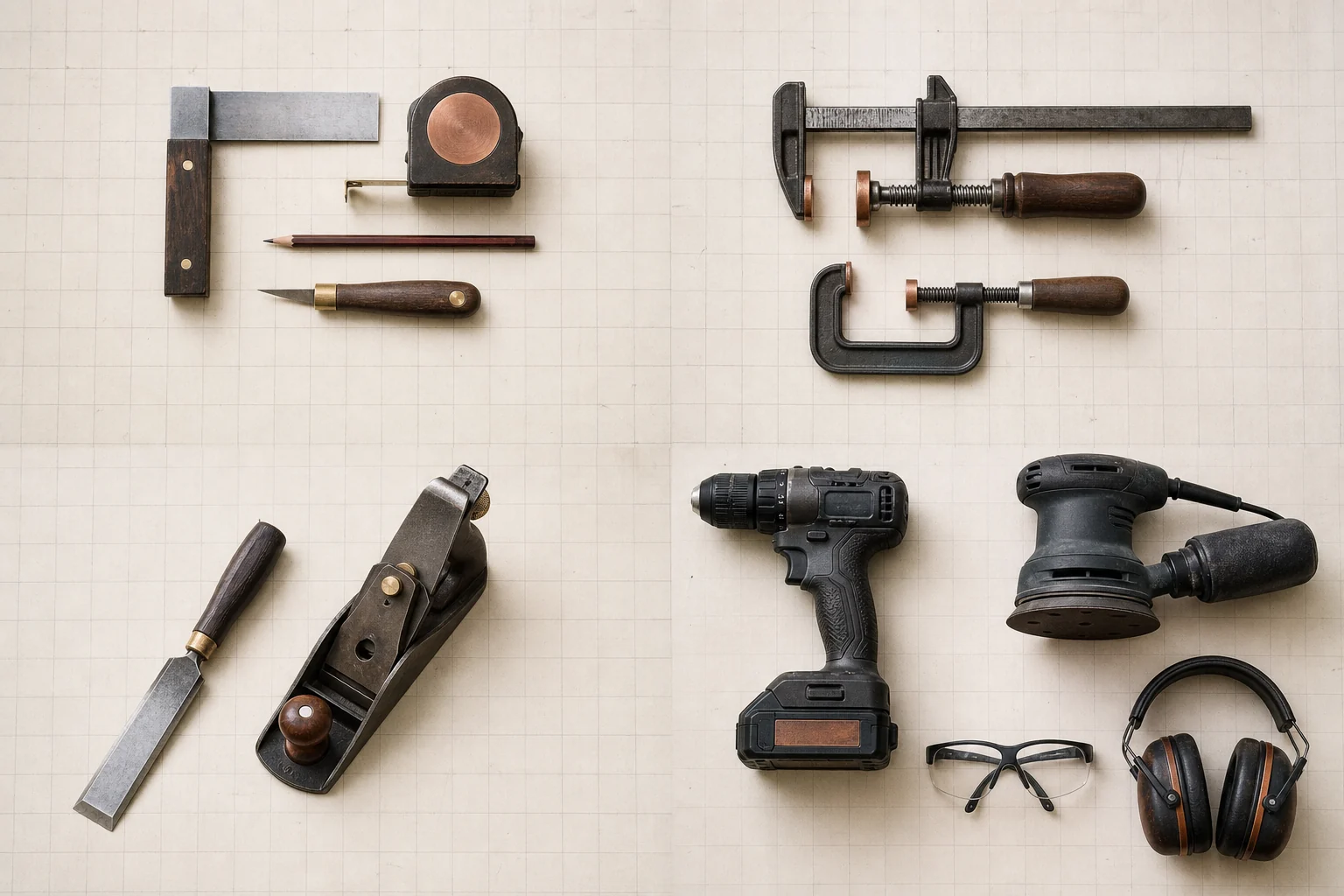
Combination square — the single most important layout and checking tool in a woodshop. Use it to mark 90-degree and 45-degree lines, check squareness, and set depths. A 12-inch combination square is the most useful size.
Marking gauge — for scribing a line parallel to an edge, essential when fitting joints or trimming to a line. A simple wheel-style marking gauge is inexpensive and accurate.
Hand saw — a Japanese-style pull saw cuts on the pull stroke and is dramatically easier for beginners than a Western push saw. An 8-10 inch dozuki or ryoba handles most crosscuts and rip cuts on smaller stock.
Block plane — for cleaning up end grain, chamfering edges, and trimming small amounts of material. A well-tuned block plane does things sandpaper cannot.
Chisels (set of 4) — sizes 1/4, 1/2, 3/4, and 1 inch cover nearly every mortise, hinge gain, and paring task a beginner will encounter. Buy an inexpensive set first; upgrade the 1/2-inch chisel when you know what sharpness feels like.
Mallet — for driving chisels. A wooden or rubber mallet protects chisel handles and gives better control than a hammer.
Marking knife — for precise layout lines before cutting. A pencil line is wide; a knife line is a single fiber and gives a cleaner result at the cut.
Clamps (at least 4) — the most under-purchased tool category. Start with four 6-inch F-clamps or bar clamps; add more as projects grow. You will always want more clamps.
Workbench or solid work surface — not a tool, but essential. A sturdy surface to clamp work to is the foundation everything else depends on.
Power Tools: Which to Add First
For most beginners, one power tool changes everything more than any other: a random orbital sander. It handles the finish prep that takes hours by hand and produces more consistent results.
The second most impactful power tool for beginners is a drill/driver combo kit (drill plus impact driver). Used for drilling holes and driving screws, it covers a huge range of tasks across every project type.
After those two, the next power tool depends on your project direction:
Building furniture and cabinets — a circular saw with a good straight-edge guide, or a miter saw. Working with reclaimed or rough lumber — a thickness planer or hand planes. Small decorative projects and boxes — a scroll saw or band saw.
Do not buy a table saw as your first stationary tool. It is the most capable — and the most dangerous — tool in the shop. Learn to cut accurately with a circular saw or hand saw first.
The Complete Beginner Tool Comparison
The table below lines up each tool by priority, primary use, and whether new or used is the smarter buy.
Tools Beginners Often Buy Too Early
Router — extremely versatile but requires jigs, bits, and experience to use safely. Better to add after you have a few projects under your belt.
Jointer — valuable for flattening boards, but expensive, space-intensive, and not needed if you buy surfaced lumber (S2S or S4S) from your supplier.
Lathe — only if turning bowls or spindles is your primary interest. It serves a narrow range of projects.
Biscuit joiner — useful for alignment, but dowels and pocket screws solve the same problem more cheaply for beginners.
Oscillating multi-tool — handy for remodeling tasks, but rarely needed in a clean woodshop workflow.
Where to Buy: New vs Used
Hand tools are excellent used buys. Old chisels, planes, and saws from flea markets and estate sales are often high-quality tools that just need sharpening. Learning to sharpen and restore a vintage plane teaches you more about edge geometry than reading about it ever will.
Power tools are generally better bought new for beginners. Used power tools may have worn bearings, damaged cords, or missing guards — problems that are hard to spot without experience.
Mid-range brands at hardware stores hit a good quality-to-cost balance for beginners. You do not need professional-grade tools to make excellent furniture; you do need tools that work consistently.
The One-Tool-at-a-Time Rule
The most expensive mistake beginning woodworkers make is buying everything at once before knowing what they actually need. Instead: buy the tool when a specific project demands it, use it for several projects, then evaluate whether it earns a permanent spot.
This approach builds a tool kit matched to the work you actually do — not a collection of gear based on what a YouTube channel or catalog says you need. It also means every tool purchase is immediately useful, not theoretical.
| Tool | Priority | Primary use | Buy new or used? |
|---|---|---|---|
| Tape measure | Essential, Day 1 | Measuring and layout | New (accuracy matters) |
| Combination square | Essential, Day 1 | Layout lines, checking square | New or quality used |
| Hand saw (pull saw) | Essential, Day 1 | Crosscuts and rip cuts | New (inexpensive) |
| Clamps (x4 minimum) | Essential, Day 1 | Holding work during glue-up | New or used |
| Drill/driver combo | Essential, Day 1 | Drilling holes, driving screws | New (kit deals are good value) |
| Random orbital sander | Essential, early | Finish sanding all surfaces | New |
| Chisels (1/4, 1/2, 3/4, 1 in) | Essential, early | Mortises, paring, trimming | New set or quality used |
| Block plane | Important | Cleaning end grain, chamfering edges | Quality used (often better than new) |
| Mallet | Important | Driving chisels safely | New or used |
| Marking gauge | Important | Scribing parallel layout lines | New (inexpensive) |
| Circular saw | Add when cutting sheet goods or long boards | Breaking down sheet goods, crosscuts | New |
| Miter saw | Add when doing lots of crosscuts | Accurate square and angled crosscuts | New or used (inspect carefully) |