The Short Answer
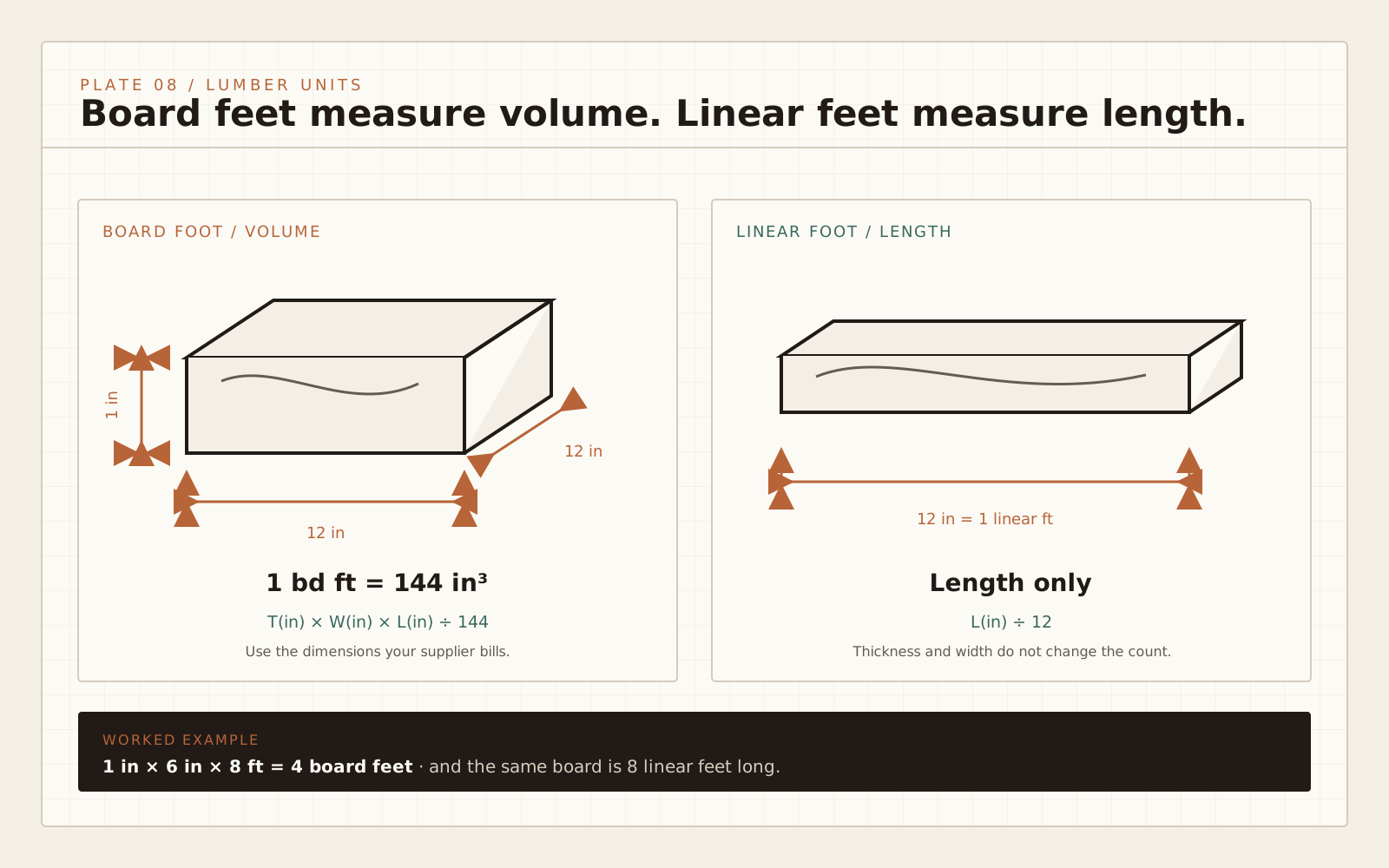
- Linear foot = a length of 12 inches. No width, no thickness.
- Board foot = a volume unit: 144 cubic inches (equivalent to 12" × 12" × 1").
A 10-foot piece of trim is always 10 linear feet, regardless of how wide or thick it is. That same piece, if it's 3 inches wide and 1 inch thick, is 2.5 board feet — because board footage depends on all three dimensions.
What Is a Linear Foot?
A linear foot (sometimes spelled "lineal foot") is simply a straight measurement of length: 12 inches equals 1 linear foot. Width and thickness are irrelevant.
Linear feet work well when products come in standardized cross-sections and you're only choosing how long to cut them:
- Baseboard and crown molding (always the same profile, just different lengths)
- Fence boards (same width and thickness from one end to the other)
- PVC pipe or electrical conduit
- Flooring sold by the bundle (often listed in linear feet per bundle)
When you buy 20 linear feet of baseboard, you're getting 20 feet of that specific molding profile — no conversion needed.
What Is a Board Foot?
A board foot is a unit of lumber volume. One board foot equals 144 cubic inches, which you can picture as:
- A piece 12" long × 12" wide × 1" thick, or
- A piece 6' long × 2" wide × 1" thick, or
- Any other combination where length × width × thickness = 144 cubic inches
The formula: board feet = length (ft) × width (in) × thickness (in) ÷ 12
See the Board Foot Calculator to run these numbers for any board.
The Key Difference: Length vs Volume
Here's where most confusion comes from: two boards of the same length can be very different amounts of wood.
A 6-foot board that is 4/4 (1 inch) thick and 4 inches wide contains 2 board feet. A 6-foot board that is 8/4 (2 inches) thick and 8 inches wide contains 8 board feet.
Both are 6 linear feet. But the second board is four times as much material — and should cost roughly four times as much at the same species price.
Linear feet can't express this difference. Board feet can.
Which Products Use Which Unit?
The table below breaks down which unit applies to common lumber and building products.
How to Convert Between Board Feet and Linear Feet
For a specific board size, you can convert freely:
Board feet → linear feet:
linear feet = board feet × 12 ÷ (width_in × thickness_in)
Linear feet → board feet:
board feet = linear feet × width_in × thickness_in ÷ 12
Practical examples:
For 4/4 × 6" hardwood (1 inch thick, 6 inches wide):
- 1 linear foot = 0.5 board feet
- 1 board foot = 2 linear feet
For 8/4 × 8" hardwood (2 inches thick, 8 inches wide):
- 1 linear foot = 1.33 board feet
- 1 board foot = 0.75 linear feet
Note that the conversion factor changes with every board dimension. This is exactly why board feet exist — to create a universal unit that lets you compare thick slabs and thin boards on the same scale.
Why Hardwood Dealers Use Board Feet
Woodworking suppliers stock hundreds of board sizes: multiple thicknesses (4/4 through 16/4), random widths from 3 inches to 20+ inches, and lengths from 4 feet to 16 feet. Pricing everything in linear feet would require a separate price per linear foot for every possible width-thickness combination.
Board feet solve this with one price per species: walnut priced per board foot applies to every board of that thickness, whatever the width or length. You calculate board footage for each piece, multiply by the price, and get your total.
Big box stores don't face this problem. They stock a narrow range of dimensional lumber (2×4, 2×6, 1×4, 1×6) in a few standard lengths. One price per linear foot (or per piece) works fine.
Bottom line: if you're shopping at a specialty hardwood dealer — whether in person or online — you'll need board feet. If you're buying standard dimensional lumber at a home center, linear feet (or just "per piece") is the norm.
| Product type | Unit used | Why |
|---|---|---|
| Hardwood lumber (walnut, maple, cherry…) | Board feet | Random widths and thicknesses — volume needed for fair pricing |
| Dimensional lumber (2×4, 2×6…) | Linear feet or per piece | Standardized cross-sections; length is the only variable |
| Baseboard, crown, and trim molding | Linear feet | Fixed profile; only length varies |
| Rough-sawn slabs and live-edge boards | Board feet | Wildly varying dimensions |
| Fence boards (pre-cut) | Linear feet or per piece | Standard width and thickness |
| Hardwood flooring | Square feet or linear feet per bundle | Sold in standardized widths |
| Exotic wood pen blanks / small pieces | Board feet or per piece | Varies by seller |
| Plywood sheets | Per sheet (sq ft implied) | Fixed 4×8 ft size; thickness specified separately |