The short answer
Buy S4S lumber when you want predictable, nearly project-ready stock and do not have a complete milling setup. Buy rough-sawn lumber when you have a reliable way to flatten, straighten, and thickness boards and you value control over final dimensions and grain layout. Neither is automatically the better value; the correct comparison is usable parts after milling, plus your time and equipment.
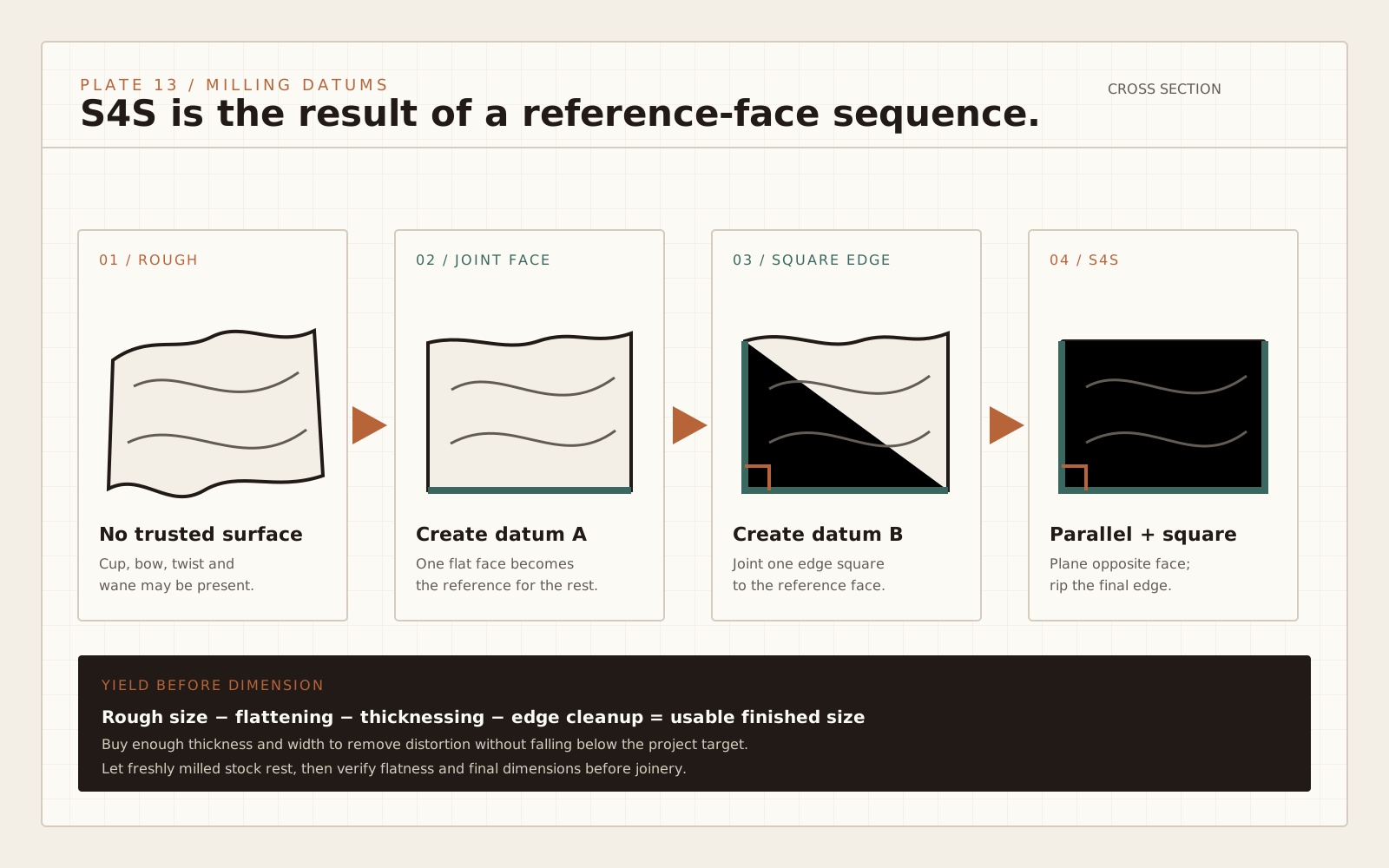
S4S means surfaced on four sides: both broad faces and both edges have been machined. Rough stock still carries saw texture and may not have a flat face or straight edge. Between those endpoints are S2S and S3S products, but lumberyards do not always use the terms identically. Ask which faces and edges were processed.
What rough, S2S, S3S, and S4S mean
Rough-sawn lumber generally needs a full milling sequence. It may be sold in random widths with live or waney edges. S2S usually means the two faces were surfaced, often parallel, while the edges remain rough. S3S commonly adds one straight edge. S4S adds a second surfaced edge and arrives at a consistent width.
Those labels describe operations, not perfection. A surfaced board can move after milling, especially when stored in different humidity. S4S does not guarantee that every board is dead flat, square, or ready for finish. Inspect it and expect at least light jointing, ripping, or sanding where the project requires furniture-level accuracy.
Rough stock offers extra material around the future part. That margin can help recover a particular final thickness, select the best face, or shift a cut around defects. It can also hide defects until the first planer pass exposes the grain and color. Surfaced stock makes visual selection easier because the faces are already readable.
Choose by the tools you actually own
The conventional rough-lumber workflow uses a jointer to create one flat face and a straight square edge, then a planer to make the second face parallel and a table saw to rip the final edge. There are alternatives: a planer sled can flatten a face, a track saw can establish an edge, and hand planes can do the entire job. The alternative must be a repeatable process, not a hope that the planer alone will remove twist.
If you own only a miter saw, circular saw, drill, and sander, S4S is usually the lower-risk purchase. You can focus on accurate cuts and joinery instead of building a milling system for one project. If you regularly build furniture and already maintain a jointer, planer, dust collection, and material-handling space, rough stock can provide useful control.
Consider board size too. A benchtop jointer may not handle wide boards, and a small planer may not flatten them without a sled. Long, heavy stock needs safe infeed and outfeed support. Buying rough material that exceeds the shop's capacity can turn a theoretical saving into a milling service bill.
Compare usable yield, not just rack price
Rough lumber often has a lower price per board foot because the buyer performs the milling, but that is not the whole cost. Include the board area lost to sapwood, wane, checks, cup, twist, and rough-cutting around defects. Include machine time, blade and cutter wear, dust collection, and disposal. Then compare the number of finished parts you can obtain.
S4S carries the supplier's milling labor and may have less extra thickness. It can reduce waste in a small shop because dimensions are visible and repeatable, but fixed widths can force you to buy more linear footage. It can also be a poor match when the plan calls for a nonstandard finished thickness.
Make a rough cutting diagram for both options. For random-width rough stock, map clear parts onto actual boards. For S4S, map parts onto the fixed widths available. Use board-foot and lumber-cost calculations on the purchase quantity, then judge cost per usable part rather than cost per label.
Inspecting each type at the lumberyard
For rough lumber, carry a scraper, small block plane, or permission-approved spray bottle only if the yard allows it; the goal is to reveal enough surface to read color and grain. Check end grain for growth-ring orientation and defects. Sight for twist, bow, and crook. Measure the thinnest area that must survive flattening.
For S4S, lay a reliable straightedge across and along the board. Check whether the edges are square to the faces. Look for planer snipe, torn grain, burn marks, and movement that occurred after surfacing. Measure actual thickness and width rather than assuming every supplier uses the same target.
For either type, select boards for the cut list. Long straight-grained areas suit rails and legs; wide attractive areas suit visible panels. A less-perfect board may be excellent for short parts. Buying by board quality alone can waste premium material on components where it adds no value.
Workflows for rough and surfaced stock
With rough stock, acclimate as appropriate, mark defects, rough-cut parts slightly oversize, flatten one face, straighten one edge, plane the opposite face, rip to width, and make final crosscuts. Milling shorter rough blanks can reduce thickness loss, but preserve extra length where grain matching or safe machine handling requires it.
With S4S, verify flatness first. Establish a reference face and edge, then correct only what the project needs. Crosscut and rip parts, label their orientation, and perform a test joint before batch production. Do not assume the factory edge is suitable for a glue line without checking.
The best buying habit is flexible: choose rough lumber when control creates value, surfaced lumber when speed and access create value, and paid milling when it solves a capacity problem cleanly.
| Factor | Rough-sawn | S4S |
|---|---|---|
| Starting condition | Saw texture; requires full milling | Both faces and edges surfaced |
| Tool demand | High unless the yard mills it | Lower; basic sizing tools may be enough |
| Dimension control | High if enough material remains | Limited to purchased thickness and width |
| Defect visibility | Some grain and defects stay hidden | Faces are easier to inspect |
| Project speed | More preparation | Faster path to joinery |
| Best fit | Equipped shops and custom dimensions | Beginners, small shops, and fast builds |
Primary references
Use the current product label, technical data sheet, safety data sheet and machine manual for the exact item in your shop. These primary references frame the general guidance on this page.
Frequently asked
What does S4S mean in lumber?
It means surfaced four sides: both faces and both edges have been machined. Check the individual board because surfaced does not always mean perfectly flat and square.
Is rough lumber always cheaper?
Its rack price per board foot may be lower, but usable yield, milling time, tool wear, and defects determine the real project cost.
Can a planer flatten rough lumber by itself?
A planer makes one face follow the other; it does not reliably remove twist without a flat reference or sled. Establish one flat face first.
Is S2S ready to build with?
Usually the faces are surfaced, but the edges may still need straightening and squaring. Confirm the yard's definition and inspect the stock.
Which lumber is better for a beginner?
S4S is often easier when the shop lacks a jointer and planer. Rough lumber becomes practical when a dependable milling method is available.