The practical difference
Baltic birch is a plywood construction category, not merely a birch-colored face. True Baltic birch is made with birch veneers through the core, typically using more, thinner plies and fewer internal voids than ordinary domestic birch-faced plywood. Regular "birch plywood" may only describe the face veneer over a softwood, poplar, mixed, MDF, or particleboard core.
Choose Baltic birch when exposed edges, small precision parts, routed joinery, repeated fasteners, or consistent core behavior are central to the design. Choose a good cabinet-grade veneer-core panel when a large decorative face, standard sheet format, lower weight, or matching hardwood veneer matters more than an all-birch edge.
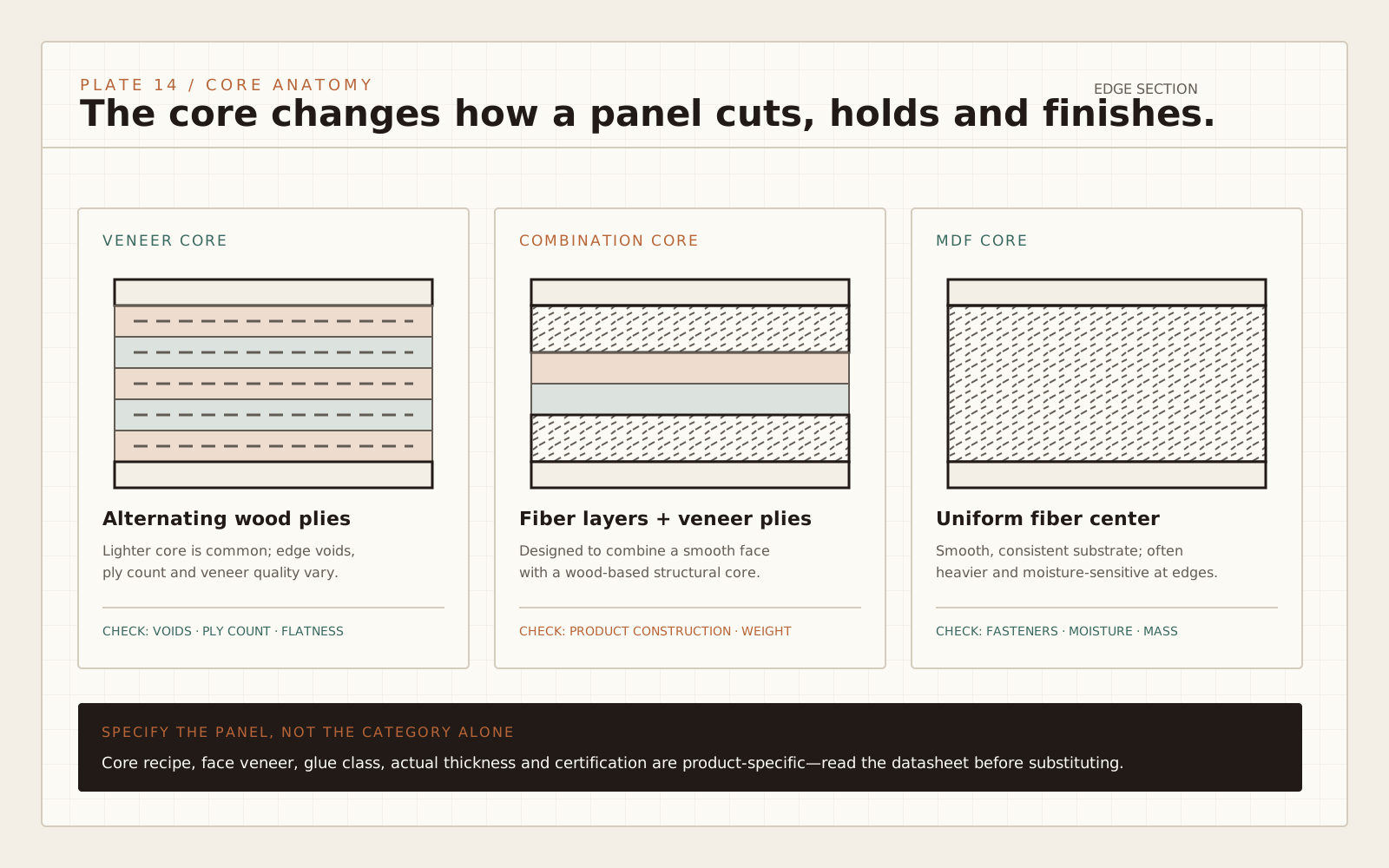
Core construction matters more than the face name
Two sheets labeled birch can behave very differently. The Wood Database describes Baltic birch as all-birch plies without softwood or filler layers and notes that the thinner plies create a higher ply count for a given thickness. A domestic birch panel can have an attractive face over a very different interior.
Look at the edge. Count the layers, check whether they are uniform, and scan for gaps. A dense, consistent core supports narrow fingers, dados, box joints, threaded inserts, and exposed edges more predictably. A lower-ply core may still be excellent for a cabinet side, but a hidden void can appear exactly where a screw or routed groove lands.
Face quality is separate. Baltic grading systems describe the two outer faces with designations such as B/BB, while North American hardwood panels may use a different face/back system. Do not compare the letters without confirming the standard.
Where Baltic birch earns its place
Drawer boxes are a classic fit because the edges can remain visible, grooves pass through a consistent core, and relatively narrow parts need reliable structure. CNC-routed organizers, shop jigs, templates, toys, boxes, and furniture with exposed layered edges can also benefit.
It is especially useful when the edge is the design. Uniform light-and-dark ply lines can be sanded and clear-finished rather than covered. That eliminates edge banding but increases the need for clean cuts and thoughtful corner joints.
Small parts benefit because a high-quality core is less likely to lose an entire section to a void. However, do not assume every panel sold under the name has identical quality. Supply chains and substitute products vary, so inspect the actual sheet and ask for its origin and specification.
When regular cabinet plywood is the better fit
A large cabinet side with only the face visible may not gain much from an all-birch core. A cabinet-grade maple, cherry, walnut, or birch panel can provide the desired face in a common sheet format and may be easier to handle. If every exposed edge receives solid-wood trim, Baltic birch's stripe is hidden.
Regular plywood can also be the practical choice when availability lets you select flatter, better-matched sheets locally. A theoretically premium panel with damaged corners, severe bow, or an unsuitable face is not better than a sound cabinet panel.
Think in parts rather than sheets. Use Baltic birch for drawer components, jigs, and exposed-edge details, then use cabinet plywood for broad case sides and doors. A mixed cut plan can capture the advantage without paying for it where it is invisible.
How to identify and inspect a panel
Start at the supplier description. Ask whether the core is all birch, what face grading standard applies, where it was manufactured, and what sheet dimensions are supplied. Baltic birch has traditionally appeared in metric and nonstandard US sheet formats, although other formats and all-birch alternatives exist. Measure before planning a nested layout.
Inspect several factory edges. Look for uniform thin plies, plugs permitted by the face grade, internal gaps, and delamination. Sight for bow and twist. Compare both faces because a back grade may contain patches that affect a visible interior.
Do not rely on ply count alone. A high count is useful only when veneers are well bonded and the panel is flat. Press near suspicious edge lines, reject delamination, and compare several sheets from the same bundle. Check that face patches will land outside show parts and that any plugs are acceptable under the planned clear finish.
If the supplier offers an all-birch alternative under another trade name, compare the written construction rather than rejecting it because the label is unfamiliar. Origin, core specification, face grade, tolerances, and availability are more informative than marketing shorthand.
Measure thickness with calipers. Metric manufacture may not match the nearest imperial router bit or hardware assumption. Save an offcut as a setup gauge for dados, grooves, and box joints.
Joinery, finishing, and moisture limits
Use a sharp sheet-goods blade or track saw with a maintained splinter guard. Support the panel fully. For routed joinery, make test cuts and adjust to the measured stock; a consistent core does not make a loose dado acceptable.
Sand faces lightly so the veneer is not cut through. Exposed edges can be progressively sanded and clear-coated, but glue squeeze-out must be removed because it will show under finish. Break sharp corners gently rather than rounding through the thin outer veneer.
Baltic birch is not automatically waterproof or exterior-rated. Birch veneers can absorb moisture, swell, and decay, and bond classifications vary. For weather exposure, specify a panel designed for that service rather than assuming the word Baltic provides protection.
The premium is justified when it solves a visible edge, precision-core, or small-part problem. If the project only needs a broad decorative face, compare a good cabinet panel on its own merits.
| Factor | Baltic birch | Regular birch/cabinet plywood |
|---|---|---|
| Core | Typically all-birch, many thinner plies | Varies by product; may use other core materials |
| Internal consistency | Usually fewer voids | Ranges from excellent to void-prone |
| Exposed edge | Often used as a finished feature | Usually banded or trimmed |
| Face options | Birch grading system | Many hardwood species and grades available |
| Best use | Drawers, jigs, CNC parts, exposed joinery | Large cabinet faces and general casework |
| Moisture | Not automatically exterior or waterproof | Depends on bond classification and product |
Primary references
Use the current product label, technical data sheet, safety data sheet and machine manual for the exact item in your shop. These primary references frame the general guidance on this page.
Frequently asked
Is Baltic birch the same as birch plywood?
No. Baltic birch usually means an all-birch multi-ply construction, while birch plywood may only have a birch face over another core.
Does Baltic birch have voids?
High-quality panels are known for fewer voids, but natural and manufacturing variation still exists. Inspect factory edges and the product specification.
Does Baltic birch need edge banding?
Not when the layered edge is part of the design. It can be sanded and finished, while regular cabinet plywood is more often banded or edged with solid wood.
Is Baltic birch waterproof?
No. The birch and glue system must be specified for the exposure. Do not use the name as a substitute for an exterior or marine rating.
Why does my router bit not fit Baltic birch thickness?
Many panels use metric dimensions that do not match nominal imperial bits. Measure the sheet and make a test dado with an offcut.