Why Wood Moves
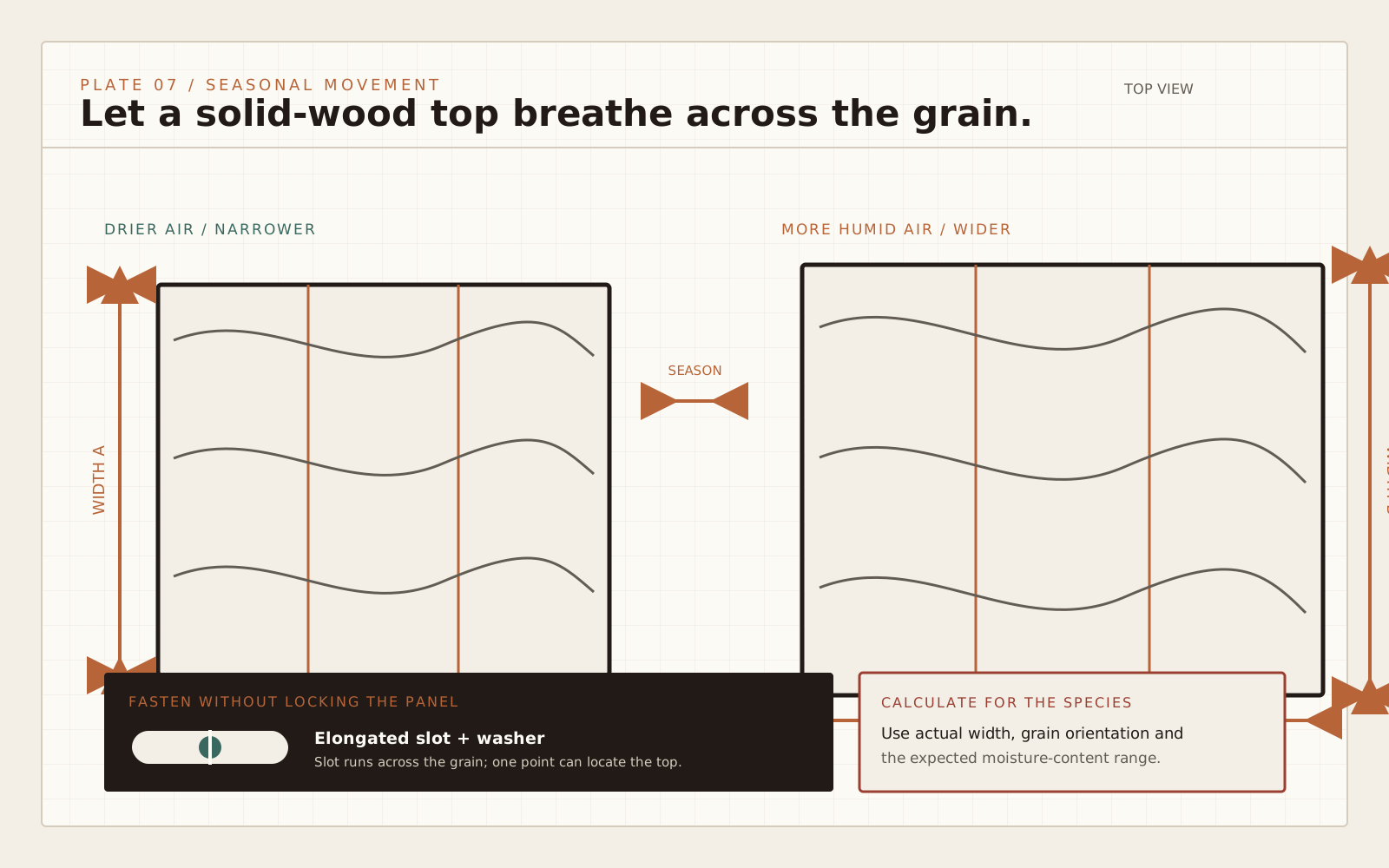
Dried lumber still contains some moisture in its cell walls. When the relative humidity around a piece of wood rises (summer, rainy seasons), the cell walls absorb moisture and the wood swells. When humidity drops (winter, heated interiors), the cell walls release moisture and the wood shrinks.
This process never stops. Even fully dried, finished furniture adjusts its moisture content to match the environment. The goal isn't to stop movement — it's to design around it.
Moisture content (MC) is the key variable: the percentage of water weight relative to the wood's oven-dry weight. Most furniture-grade lumber is kiln-dried to roughly 6 to 8 percent MC, approximating typical US interior conditions. But seasonal humidity swings still cause measurable movement from that baseline.
The Three Directions of Movement
Wood moves differently in each of its three axes — and the differences are dramatic.
Tangential
Tangential movement runs parallel to the growth rings, through the face of a flat-sawn board. This is the largest movement direction — where wood swings the most with humidity changes. When a wide tabletop cracks or a drawer sticks in summer, tangential movement is almost always responsible.
Radial
Radial movement runs perpendicular to the growth rings, from bark toward the pith. It's the direction you see movement in quarter-sawn lumber. Radial movement is typically significantly less than tangential — often roughly half — which is the reason quarter-sawn boards are prized for dimensional stability in critical applications.
Longitudinal
Movement along the grain (end to end) is so small it's essentially negligible in practice — usually a small fraction of one percent across the full range of humidity. You don't need to design around it.
The practical summary: wood moves primarily in width and thickness, almost never in length. A 30-inch-wide tabletop can expand and contract significantly across its width season to season; its length stays nearly constant.
Flat-Sawn vs Quarter-Sawn: Why Cut Matters
How a board is cut from the log determines which direction of movement affects its width — and flat-sawn and quarter-sawn behave very differently.
The table below compares the two cuts side by side.
For highly stable applications — instrument soundboards, fine furniture tops, door panels — quarter-sawn is worth seeking out despite its higher cost. For general construction and projects where some seasonal movement is acceptable, flat-sawn works fine with proper design accommodations.
How Much Movement to Expect
The actual amount of movement depends on three things:
- Species — some woods are more stable than others (more on this below)
- Width of the piece — wider boards move more in absolute terms
- Humidity swing — the greater the seasonal humidity difference, the more movement
As a rough planning principle: a wide flat-sawn board in a dry climate can move noticeably across seasons. The same board quarter-sawn would move considerably less.
Rather than memorizing species-specific rates, the more useful habit is: design for movement, and let the wood move. Use the design solutions below rather than fighting the wood.
Design Solutions for Wood Movement
These are the standard techniques that allow wood to move without destroying a joint or panel:
Floating panels — the most common solution for cabinet door panels and frame-and-panel furniture. The center panel sits in a groove but is not glued; it can expand and contract freely. If glued solidly at all four edges, a flat-sawn panel will either split or blow out a joint.
Breadboard ends with elongated holes — breadboard ends (cross-grain strips on the end of a tabletop) prevent cupping but must allow the top to expand. The technique: glue only the center inch or two, and use elongated screw holes (slots) outward from the center so the top can move side to side.
Figure-8 fasteners and Z-clips — tabletop attachment hardware designed to hold a top to a base while allowing it to move. Far better than screwing straight down through the rail.
Expansion gaps in flooring — hardwood floor installation always leaves an expansion gap at the perimeter walls (typically covered by baseboard). The floor can expand into this gap in humid seasons.
Wood movement in frames — picture frames and mirror frames are generally small enough that movement is negligible across their width. Still, cross-grain glue joints in thick solid frames can develop stress over time in extreme humidity swings.
Grain direction in glue-ups — when edge-gluing panels (tabletops, shelves), orient all boards with grain running the same direction. This ensures the whole panel moves as a unit rather than fighting itself.
Species and Movement
Species and ring orientation have measurable radial and tangential shrinkage coefficients; informal labels such as “stable” are not enough for a critical fit. Use the USDA Wood Handbook or another engineering reference for the exact species, and calculate from the expected change in equilibrium moisture content.
Quarter-sawn orientation often reduces face-width movement because the board width aligns more closely with radial rather than tangential shrinkage, but actual growth-ring angle, grain deviation, juvenile wood and defects still matter. Measure representative stock and design a tolerant connection even when the calculated change is small.
Acclimating Lumber Before Building
Acclimation is a moisture-condition target, not a calendar count. Stack and sticker representative boards in conditions close to the intended service environment, allow airflow, and check multiple boards and depths with a suitable calibrated meter. A few days or two weeks can be too short or unnecessarily long depending on thickness, starting moisture and environment.
Mill uncertain stock in stages and recheck flatness and moisture between stages. Building near the expected equilibrium moisture content reduces the initial change, but it never removes seasonal movement; the joinery must still allow it.